
How to trade silver for beginners
Reading time: 11 minutes
While gold tends to claim the spotlight in financial media most of the time, silver deserves attention not only as a store of wealth with a fascinating history but also as a workhorse in modern industry and a widely traded asset class.
Silver’s history and global appeal
According to the Silver Institute, the commodity’s appeal dates back thousands of years, with mining beginning as far as 5,000 years ago. Needless to say, this metal boasts a colourful and long history, one that helped finance Roman trade routes and the European conquest of the Americas in the late 15th century. This marked the opening of the transatlantic bridge, which later enabled Europeans to discover and exploit the largest silver mines in human history.
However, silver’s industrial capabilities are what set the white metal apart from most other commodities. Per the World Gold Council, the stacked column chart below from MacroMicro, shows that gold’s contribution to technology is about 10%.
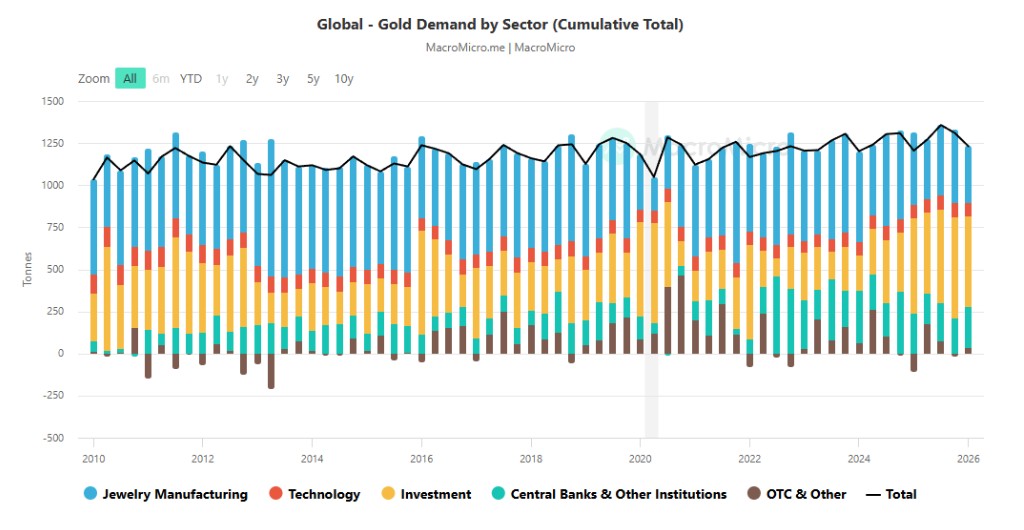
Source: MacroMicro (macromicro.me). Used with attribution for market commentary and educational purposes.
Compare this with the global demand for silver in the industrial sector, which accounts for around 60% of total demand, according to the Silver Institute (see below). These ingrained industrial ties link silver closely to the broader ups and downs of the global economy.
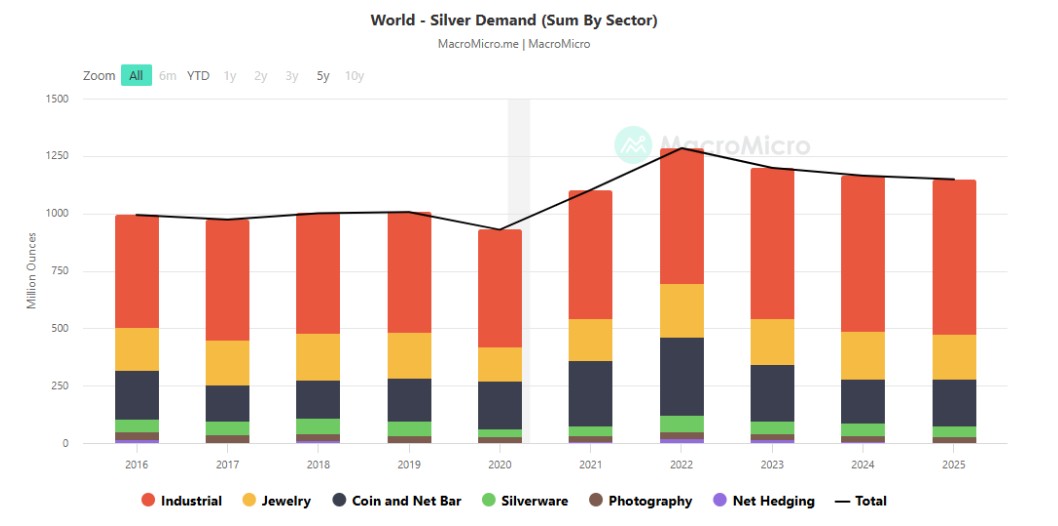
Source: MacroMicro (macromicro.me). Used with attribution for market commentary and educational purposes.
What do you need to begin trading the silver market?
Beyond a funded brokerage trading account, you will need a well-defined trading plan. This includes the strategy for entering and exiting the market, a logical approach to risk management, your trading schedule – are you a scalper or a swing trader, for example – as well as a way to record your trades and review your progress. This is usually achieved through a trading journal, which represents a detailed log of all positions and your thoughts before, during, and after the trades.
You will find that the majority of traders begin their journeys by analysing charts, focussing solely on technical analysis, attempting to decipher trending markets and plotting support and resistance. While this is a crucial piece of the puzzle, in my experience, you should start by understanding trading psychology. Following this, risk management is a key component to understand. This includes capital allocation rules and position sizing, understanding leverage and margin call mitigations, and execution parameters such as entry and exit orders (e.g., stop-loss orders). Only then would I recommend beginning to develop analytical skills.
For absolute beginners, demo accounts are widely recommended. These simulate real market conditions without exposing you to the risk of losing money – a sensible place to develop confidence before committing capital.
What financial instruments can I trade silver in?
Contracts for Difference (CFDs):
CFDs are among the most accessible ways to trade silver. With FP Markets, unlike buying and selling physical silver, you can trade the precious metal’s price action without taking physical ownership, as trades in the CFD market are cash-settled. This is not just for the spot price of silver – which is generally quoted as silver versus the US dollar (XAG/USD) – it applies to all CFD products. Another defining feature of CFDs is that they are leveraged instruments, meaning that CFD traders only need to ‘put up’ a fraction of the notional amount – this is known as ‘margin’.
Futures and options:
Silver futures and options are alternative markets in which the metal can be traded. While they operate similarly to CFDs – all three are derivatives that mirror the underlying asset’s price action – traders in futures and options can theoretically take physical delivery, though this is rarely done, if ever.
At its core, a futures contract involves essentially locking in a price today for delivery at a future date. Options contracts differ in that they give buyers and sellers the right, but not the obligation, to buy or sell an underlying asset if the option is exercised.
Stocks and ETFs (Exchange-Traded Funds):
Another route some silver traders take is to invest in physical companies through the stock market, usually by investing in silver mining stocks. However, while there will be some correlation between these companies and the price of silver, it is important to understand that company-specific factors will ultimately determine a stock’s price, such as earnings and debt levels.
To help mitigate these factors, some investors turn to ETFs. Put simply, ETFs are investment products that pool investor funds and invest in assets such as silver. Popular types of silver ETFs include physical ETFs, which involve buying and storing physical silver bullion in secure vaults, with each share of the ETFs representing a fractional ownership of silver, in addition to ‘Synthetic ETFs’, which track the price of silver through derivatives It's worth noting, though, that even silver-focused ETFs can suffer from a tracking error – a discrepancy between the ETF's performance and the actual price movement of silver.
Physical silver:
The most direct route is buying physical silver, such as bullion coins or bars. Coins, such as the Britannia silver coin from The Royal Mint or the popular Queen's Beasts range, appeal to both collectors and investors and are generally smaller amounts. Bars, meanwhile, tend to suit those looking to invest in larger amounts of silver.
However, there are practical considerations: storage, insurance, and the important note that silver cannot be stored alongside gold, as it will tarnish. Some investors choose to store their holdings with a custodian such as The Royal Mint's vault, though that comes with a storage fee.
What drives the price of silver?
Like any widely traded asset, from stocks, bonds, currencies, to commodities, market sentiment in the silver market will be impacted by a number of factors.
Given that silver is priced in USD, market volatility will, of course, be impacted by its movements. Generally, a stronger USD makes it more expensive for foreign buyers, which can weigh on silver’s demand. Conversely, a weaker USD can have the opposite effect: it will be cheaper for foreign buyers to purchase silver, thereby increasing demand for the white metal.
Economic conditions and changes in central bank interest rates can also have a noticeable effect on the price of silver. Like gold, silver is often viewed as a hedge against inflation and economic uncertainty. When broader markets wobble, investors frequently rotate out of riskier assets and into precious metals as a safe-haven asset, consequently pushing prices up. This occurs when markets enter a ‘risk-off’ environment. The same is said when markets are broadly optimistic, with both gold and silver tending to lose momentum.
Because more than half of silver's demand is industrial, slowdowns in manufacturing, electronics, or clean-energy investment can weigh heavily on prices and influence supply-and-demand dynamics.
The gold-silver ratio
Although often overlooked, the gold-to-silver ratio is a simple yet powerful metric for comparing the relative value of gold and silver. As shown in the chart below, this can easily be tracked on TradingView by simply inputting the following formula:
Gold-silver ratio = XAU/USD/XAG/USD
The ratio is currently trading at around 62.9, meaning it would take approximately 62.9 ounces of silver to buy 1 ounce of gold.
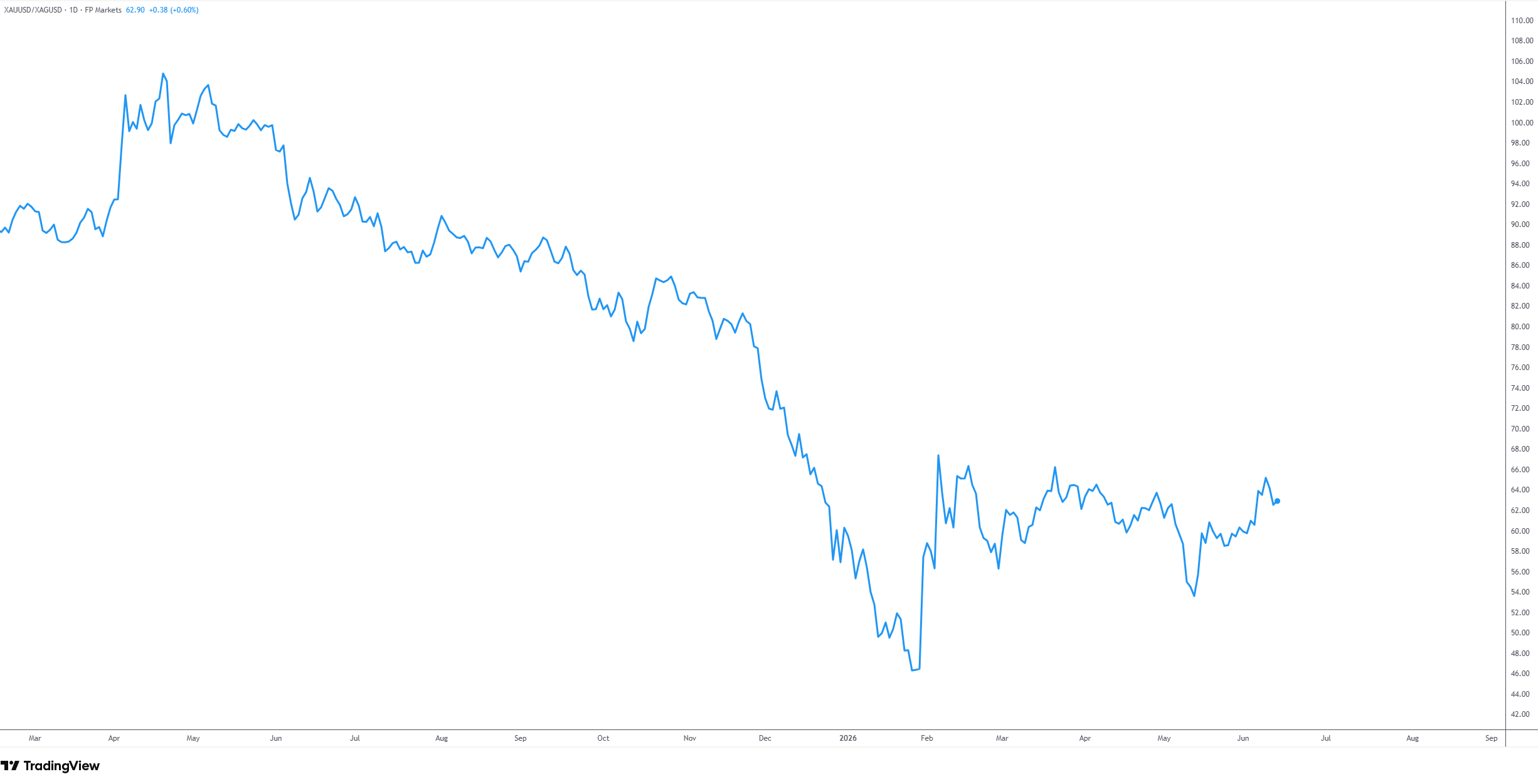
Source: TradingView
A high gold-to-silver ratio indicates that gold is outperforming silver and suggests that silver may be undervalued relative to gold, offering potential buying opportunities for silver. When the ratio is trending lower, however, this can mean the opposite: gold is underperforming silver, and that silver could be overbought and due for a selloff. Ultimately, it can help investors determine when silver is either undervalued or overvalued, and can be aided by basic technical analysis.
Technical analysis: Know your levels
Like all markets, even if you trade through fundamental analysis, understanding where you are on a chart and the key levels in your traded markets is key, in my opinion. Technical analysis aids entry into the market and helps with exit levels as well.
Being able to identify trends and plot basic support and resistance areas provides a solid foundation for improvement. This can be done across all timeframes, but it ultimately depends on whether you are a short-term trader or a longer-term investor.
For the purposes of this demonstration, my focus will be on the H1 timeframe for silver (below), which is better suited to short-term day traders or medium-term swing traders. While there are several ways to determine a market's trend, I will use price action. The chart below shows an uptrend from late March to mid-April, characterised by a series of higher highs and higher lows. This is how you determine if the market is trending higher. For new traders, always try to select the cleanest swing highs and lows in your analysis, as these trends can provide traders with opportunities to buy silver when the market dips to a higher low.
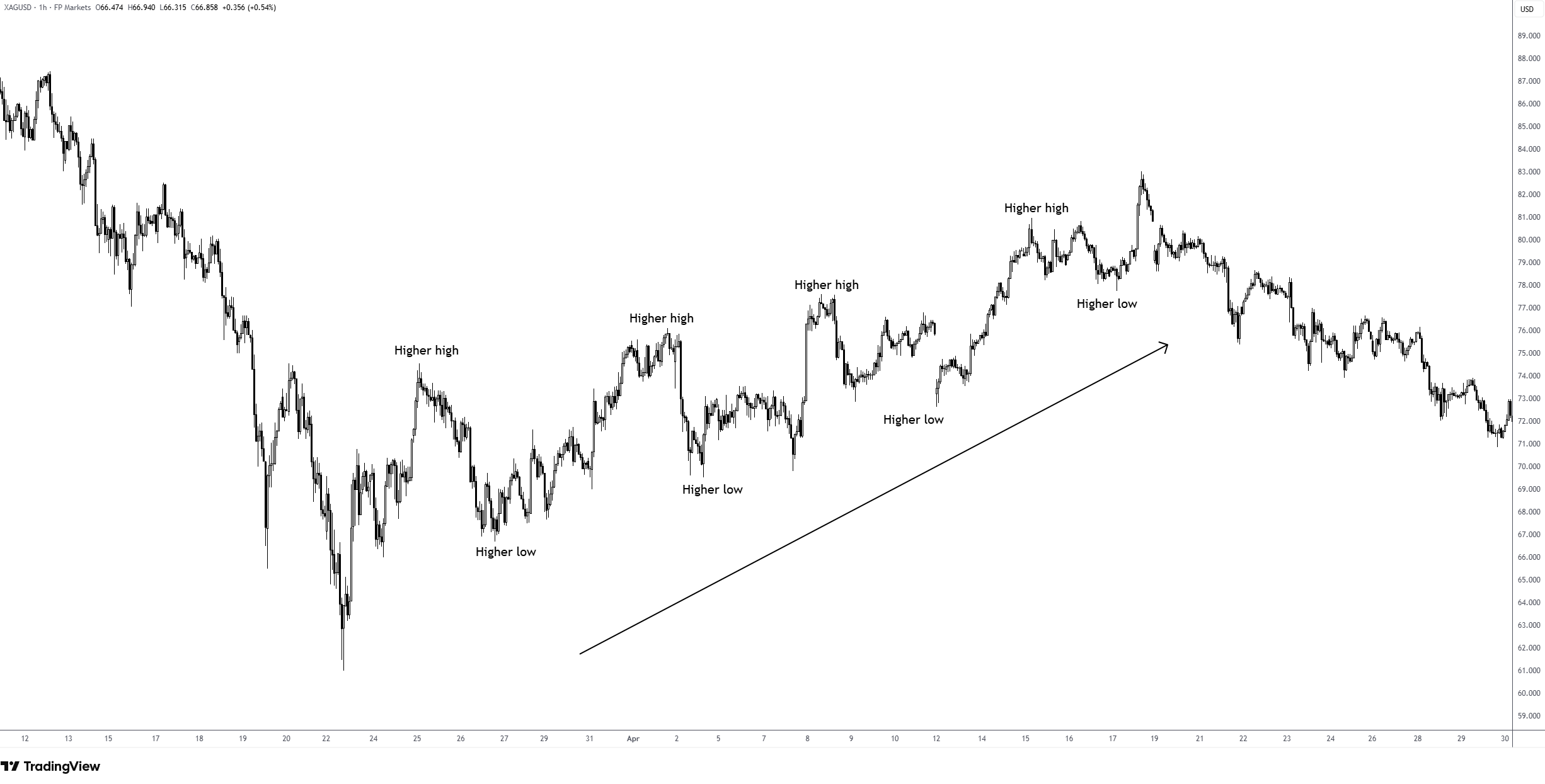
Source: TradingView
The H1 chart of silver below shows the opposite: a downward trend. This is made up of a series of lower lows and lower highs. Like an uptrend, a downtrend tends to attract traders selling silver at the lower high points – technically referred to as ‘selling into rallies’. The latest lower high has yet to complete and could be where we see sellers make a show shortly.
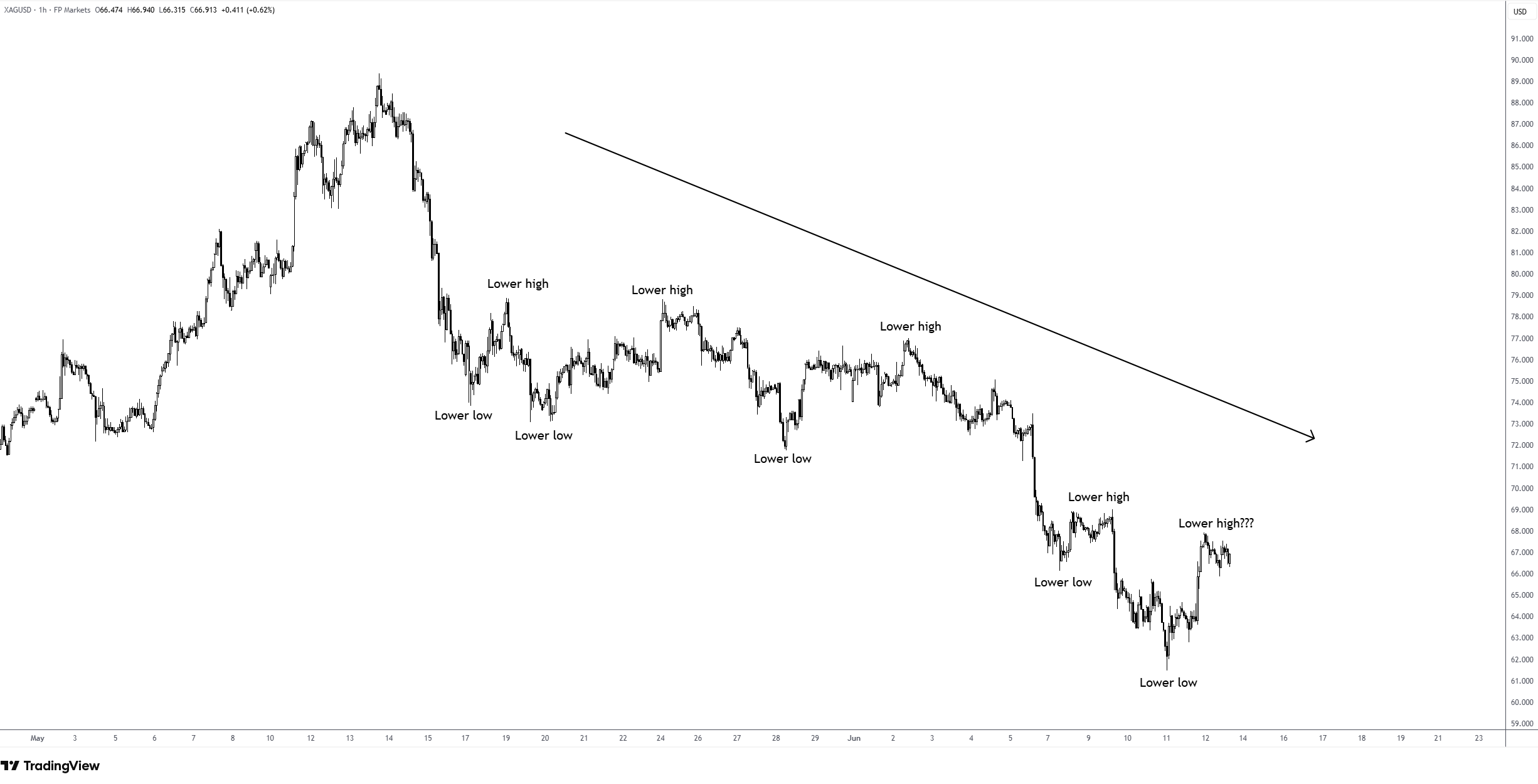
Source: TradingView
Now, if we also layer in support and resistance levels, we can begin to identify solid zones of interest aligned with the underlying trend. As you can see in the same H1 chart below, I have identified two support and resistance areas within the uptrend, essentially forming a floor for where the higher low may be found and providing a base for possible buying opportunities. You simply connect nearby areas where price has reacted to form a zone of interest and work from there. For those new to support and resistance, the team put together an in-depth post here detailing the key nuances.
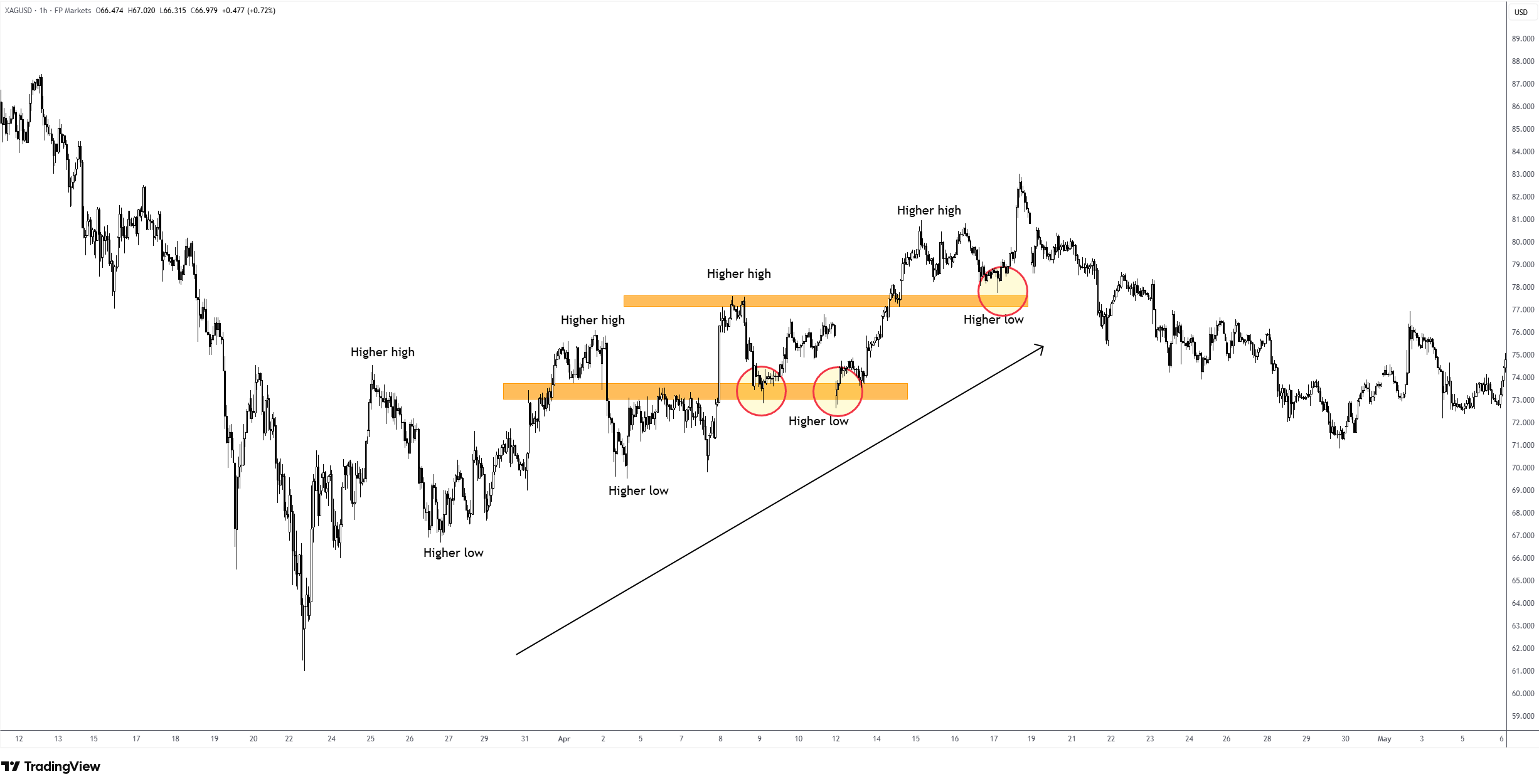
Source: TradingView
Trade silver with FP Markets
Ultimately, trading silver offers a unique dual advantage: It is both a historic store of value and a crucial industrial resource, making it a versatile asset. Succeeding in this market requires a balance of tracking core macro drivers while strictly executing a plan focused on risk management and technical entry levels. For absolute beginners, starting with a demo account is recommended as the best way to begin familiarising yourself with the market and the platform’s features before risking real capital.
Written by FP Markets Chief Market Analyst, Aaron Hill